










A saucepan is chosen first by its material: stainless steel lasts a lifetime with no coating, copper responds instantly, enamelled cast iron holds the heat, and non-stick aluminium heats up fast and nothing sticks. Then come the size, from the small milk pan to the large saucepan for pasta, compatibility with your hob (gas, ceramic glass, induction), the lid and the handle, fixed or removable. I compared 13 models on sale, from Tefal to Mauviel by way of De Buyer, Cristel, Le Creuset, Beka, Sitram and Pyrex, reading their manufacturer pages and recording their price on 07/10/2026. Each one has its drawback spelled out.
Selection
| Model | Rating | Material | Diameter | Induction | Made in | Price | See the offer |
|---|---|---|---|---|---|---|---|
| De Buyer Affinity 20 cm For a stainless steel saucepan that heats almost like copper | 4.5/5 | 18/10 stainless steel, 5 layers with an aluminium core | 20 cm | Yes | France | €127.82Price checked on 07/10/2026 | ViewSee the offer |
| Cristel Castel'Pro 16 cm fixed handle For sauces, in French stainless steel with a lifetime guarantee | 4.4/5 | 18/10 stainless steel, 5 layers | 16 cm | Yes | France | €110.00Price checked on 07/10/2026 | ViewSee the offer |
| De Buyer Prim'Appety, set of 4 saucepans 14 to 20 cm For equipping your kitchen with French stainless steel in one go | 4.3/5 | 18/10 stainless steel, diffuser base | 14, 16, 18 and 20 | Yes | France | €78.49Price checked on 07/10/2026 | ViewSee the offer |
| Beka Chef 16 cm For an everyday stainless steel saucepan at a low price | 4.3/5 | 18/10 stainless steel, 3-layer base | 16 cm | Yes | China | €32.42Price checked on 07/10/2026 | ViewSee the offer |
| Pyrex Infinity 20 cm with lid For draining and pouring without a colander | 4.1/5 | Uncoated 18/10 stainless steel | 20 cm | Yes | China | €39.95Price checked on 07/10/2026 | ViewSee the offer |
| Le Creuset Signature cast iron saucepan 18 cm For sauces that simmer for a long time | 4.1/5 | Enamelled cast iron | 18 cm | Yes | France | €249.00Price checked on 07/10/2026 | ViewSee the offer |
| Tefal Ingenio, set of 3 saucepans 16, 18 and 20 cm + handle For saving cupboard space | 4.1/5 | Aluminium, Mineralia+ non-stick coating | 16, 18 and 20 | Yes | France | €61.99Price checked on 07/10/2026 | ViewSee the offer |
| Mauviel M'Heritage 150c 1.9 L with lid For the precision of copper for sauces | 4/5 | 1.5 mm copper (90%) and 18/10 stainless steel (10%) | n/a | With a disc sold separately | France | €240.00Price checked on 07/10/2026 | ViewSee the offer |
| Beka bain-marie 16 cm For melting chocolate and making a sauce without burning it | 4/5 | 18/10 stainless steel, double wall | 16 cm | Yes | China | €34.47Price checked on 07/10/2026 | ViewSee the offer |
| Sitram Arpège, set of 3 removable-handle saucepans 16 to 20 cm For a stainless steel removable handle on a small budget | 3.9/5 | Stainless steel | 16, 18 and 20 | Yes | China | €37.01Price checked on 07/10/2026 | ViewSee the offer |
| Tefal Ingenio Natural Force 16 cm For adding to an Ingenio set | 3.9/5 | Aluminium, Mineralia+ non-stick coating | 16 cm | Yes | France | €23.99Price checked on 07/10/2026 | ViewSee the offer |
| Beka Polo 12 cm For a small saucepan for milk or a sauce | 3.9/5 | 18/10 stainless steel, 3-layer base | 12 cm | Yes | China | €13.15Price checked on 07/10/2026 | ViewSee the offer |
| Tefal Ingenio Renew ceramic 20 cm For a ceramic saucepan with no added PFAS | 3.8/5 | Recycled aluminium, ceramic coating | 20 cm | Yes | France | €20.64Price checked on 07/10/2026 | ViewSee the offer |
Ranked by our rating, then by popularity. No retailer pays for its place. Our method. Prices and availability may change. The price shown on Amazon when you buy is the one that applies.
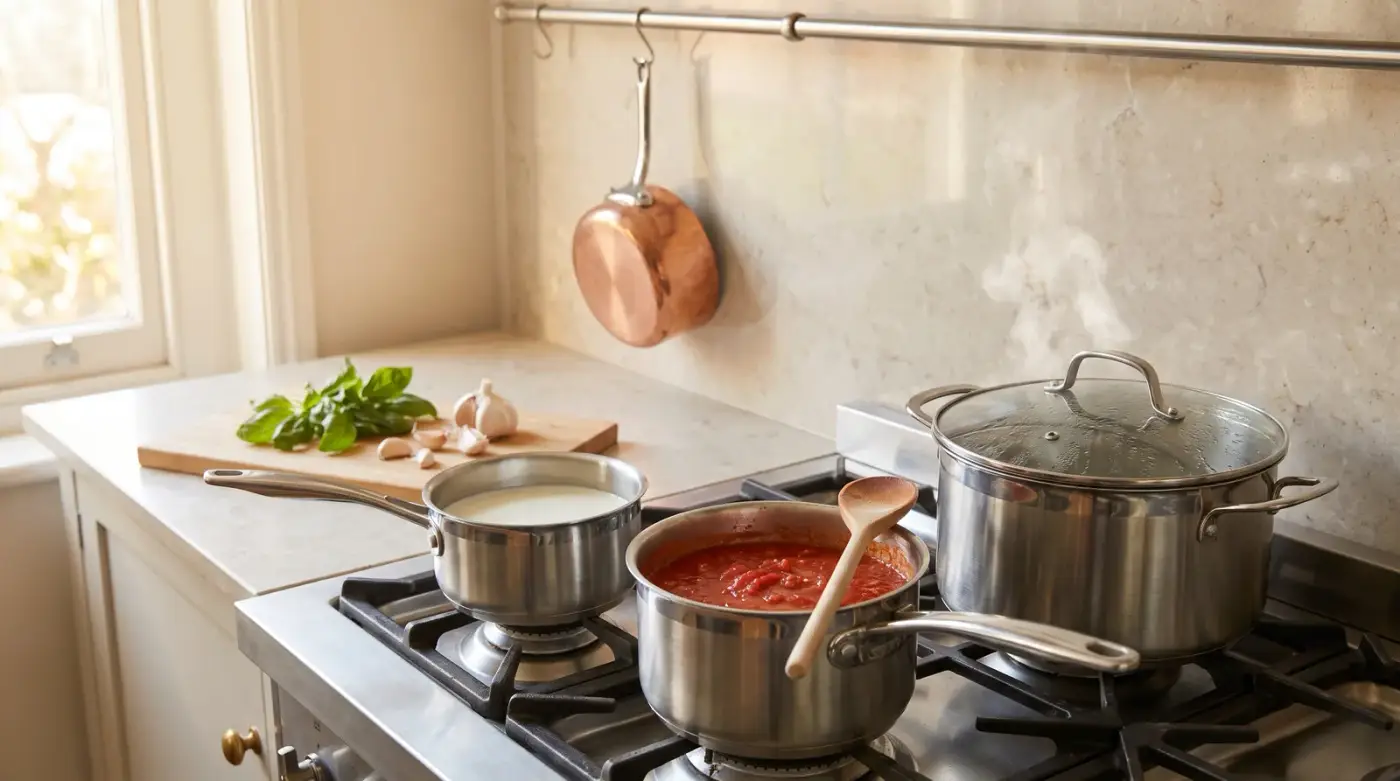
Our saucepan comparison for 2026
The grid above ranks 13 saucepans by our score, which weighs the material, heat distribution, care, versatility and price. French-made multi-ply stainless steel comes out on top: De Buyer Affinity and Cristel Castel'Pro, with their heat-diffusing bodies, heat all the way up the sides and last for decades. To settle the brands in a single ranking, with a winner per profile, our best saucepan comparison goes into the detail.
Which type of saucepan should you choose?
There are five main materials (stainless steel, copper, cast iron, non-stick aluminium, ceramic) and three special formats: the removable-handle saucepan, the bain-marie saucepan and the saucepan set. The table at the end of this section sums them up.
The stainless steel saucepan
It is the best-selling and most durable saucepan. 18/10 stainless steel does not react with food and handles the dishwasher, but it is a poor heat conductor: everything depends on the base. An encapsulated base (an aluminium disc under the pan, as on the Beka models) only heats the bottom; a 3-ply or 5-ply construction, as at De Buyer and Cristel, carries the heat all the way up the sides. For a béchamel, stainless steel needs watching and sometimes a little fat. Eight of the 13 models in our grid are stainless steel. Our stainless steel saucepan page compares this segment in detail.
The copper saucepan
Copper has the best conductivity in our selection: it heats up and cools down very fast, which is why professionals use it for caramel, jams and delicate liaisons. At Mauviel, the wall combines 90% copper with 10% 18/10 stainless steel on the inside, 1.5 mm thick. Its limits: it only works on induction with a disc sold separately, is hand wash only, tarnishes and costs a lot. It is an enthusiast's saucepan, best kept for preparations that need precision.
The enamelled cast iron saucepan
An enamelled cast iron saucepan, like Le Creuset's Signature, holds the heat for a long time and suits dishes that need to simmer, stewed fruit and rice. The enamel means no seasoning. In return, it weighs far more than stainless steel and heats up slowly. Our cast iron saucepan page covers this segment; for Staub or Le Creuset cocottes, see our Dutch oven page.
The non-stick aluminium saucepan
Aluminium is light and heats up fast. It is never bare: a non-stick coating covers it, PTFE at Tefal (the Mineralia+ of the Ingenio range). Milk and custards do not stick, cleaning is quick and the price stays low. But a coating wears: no metal utensils, no heating when empty. The Mathon guide notes that PFOA is banned in these coatings. Our aluminium or stainless steel saucepan page compares the two materials point by point.
The ceramic saucepan
Ceramic here is a coating applied to aluminium, as on the Tefal Ingenio Renew. It is non-stick without PTFE and heats up quickly, but it is more fragile: the Mathon guide describes it as not very resistant to knocks, scratches and overheating. It is a good choice for quick, healthy cooking, as long as you treat it gently. Our ceramic saucepan page goes into the detail.
The removable-handle saucepan
A single handle clips onto every saucepan in the range, and the pans then nest inside each other in the cupboard: stackable storage that saves space. This is the principle behind Tefal Ingenio, Cristel Mutine and Sitramovible. Without the handle, the saucepan goes in the oven and the fridge. Two warnings: a saucepan sold on its own is useless without the handle, and each brand has its own system, incompatible with the others.
Saucepan sets and cookware sets
A set of 3 or 4 saucepans from 14 to 20 cm costs less than buying them one by one: De Buyer sells its 4 Prim'Appety, Sitram its 3 Arpège. For a full cookware set, with frying pans, a sauté pan and a stockpot, our cookware set page compares the options; for soups and pasta in large quantities, the stockpot has its own page.
| Type of saucepan | Best for | Strength | Limit | Price on 07/10/2026 |
|---|---|---|---|---|
| Stainless steel | Everything, from milk to vegetables | Durable, no coating | The base makes the quality | 13.15 to 127.82 euros |
| Copper | Sauces, caramel, jam | Heat responsiveness | Induction with a disc, care | 240.00 euros |
| Enamelled cast iron | Simmered sauces, stewed fruit | Holds the heat | Heavy, expensive | 249.00 euros |
| Non-stick aluminium | Milk, custards, low-fat cooking | Light, nothing sticks | Coating that wears | 23.99 to 61.99 euros |
| Ceramic | Quick cooking without PTFE | Non-stick without PTFE | Fragile | 20.64 euros |
| Bain-marie | Chocolate, custards, delicate sauces | Cannot burn | Single use | 34.47 euros |
The price shown on Amazon when you buy is the one that applies.
Small or large saucepan: which size should you choose?
Choose the diameter for the dish and the number of people. A small saucepan of 12 to 14 cm is enough to warm milk or make a sauce; a 16 cm handles vegetables for two; a large saucepan of 20 cm or more suits pasta, rice and soups for four. Here are the capacities Beka publishes for its Chef range, as a guide:
| Diameter | Capacity (Beka Chef) | Typical use |
|---|---|---|
| 14 cm | 1.2 L | Milk, sauce for two |
| 16 cm | 1.7 L | Vegetables, rice for two |
| 18 cm | 2.4 L | Side dish for four |
| 20 cm | 3.3 L | Pasta, soup for four |
The height of the sides changes everything: at 16 cm, the Cristel Castel'Pro holds 1.4 L and the Beka Chef 1.7 L. Look at the litres more than the centimetres. Beyond 3 litres, you are in stockpot territory. Also choose a diameter that matches your burner: Mathon advises a saucepan wider than the flame, so as not to damage the outside.
Bain-marie saucepan: what is it for?
A bain-marie saucepan heats food through water, never directly. On the Beka, the water sits between two stainless steel walls, is filled through the handle and an indicator shows the level; when steam escapes, the water is boiling. The contents can neither burn nor stick: it is the tool for melted chocolate, custard, hollandaise sauce and baby bottles. A mixing bowl set over a pan of simmering water does the same job, less conveniently. Check compatibility: the Ibili model we left out does not work on induction.
How to choose a saucepan
A saucepan is chosen on five criteria: compatibility with your hob, the base, the lid, the handle and care.
Saucepan for ceramic hob, gas or induction: compatibility
On gas, electric plates and ceramic glass hobs, every saucepan in our selection works. Induction needs a magnetic base: the stainless steel in our models is, the Mauviel is not without a disc. On a ceramic hob, choose a perfectly flat base that touches the whole plate. The simple test, given by Mathon: a magnet that sticks underneath means the saucepan works on induction. A small 12 cm saucepan can also be too narrow for some induction zones; our induction saucepan page covers these cases.
The base and its thickness
A thick base spreads the heat and stops the sauce from catching in the middle. Our selection has three levels: the 3-ply encapsulated base (Beka Chef and Polo), the diffuser base (De Buyer Prim'Appety) and 5-ply construction all the way up (De Buyer Affinity, Cristel Castel'Pro). The more layers in the wall, the more even the cooking, and the higher the price.
The saucepan lid
Many saucepans are sold without a lid: 8 of the 13 models in our grid. A lid brings water to the boil faster and limits splashes. Glass lets you see the cooking; the Pyrex Infinity's lid has a built-in strainer and pouring lip. Le Creuset's Signature has a vented lid against boil-overs, according to its Amazon page. If you buy one at a time, check that a lid of the same diameter exists in the range.
The handle: fixed or removable
A riveted stainless steel handle, as on the Cristel and De Buyer models, lasts as long as the saucepan and goes in the oven. Bakelite stays cool to the touch (Beka Polo) but cannot go in the oven. A removable handle saves space and goes from hob to fridge, at the cost of a mechanism to handle every time.
Care and the dishwasher
Stainless steel is dishwasher safe according to the Beka, Cristel and Pyrex pages. Mathon notes that regular washing can leave a white deposit on the rivets, with no effect on cooking. The Mauviel is hand wash only, and Tefal advises hand washing for its non-stick pans. To loosen residue that has stuck, Mathon suggests heating a little water with vinegar rather than scraping. Also avoid putting a hot saucepan under cold water, to prevent thermal shock.
What budget for a saucepan?
A saucepan costs from 13.15 to 249.00 euros according to our checks on 07/10/2026. The budget follows the material, the construction and the country of manufacture more than the size.
- Under 25 euros: the small 12 cm Beka Polo (13.15 euros), the 20 cm Tefal Ingenio Renew ceramic (20.64 euros) and the 16 cm Tefal Ingenio Natural Force (23.99 euros), the last two without a handle.
- From 30 to 65 euros: the 16 cm Beka Chef (32.42 euros), the Beka bain-marie (34.47 euros), the Sitram Arpège set (37.01 euros), the Pyrex Infinity with lid (39.95 euros) and the Tefal Ingenio set with handle (61.99 euros).
- From 75 to 130 euros: the set of 4 De Buyer Prim'Appety (78.49 euros), the 16 cm Cristel Castel'Pro (110.00 euros) and the 20 cm De Buyer Affinity (127.82 euros).
- Over 200 euros: the Mauviel M'Heritage (240.00 euros) and the 18 cm Le Creuset cast iron (249.00 euros).
The price shown on Amazon when you buy is the one that applies.
The models we did not keep
The Tefal Ingenio Emotion set (54.99 euros on 07/10/2026) has a page that talks about stainless steel, a titanium coating and "3 frying pans" for a saucepan set all at once. The set of 3 Cristel Mutine removable-handle saucepans was only offered by a third-party seller, at 249.00 euros with 2 left. The Ibili bain-marie (19.99 euros) does not work on induction according to its page. The 12 cm De Buyer copper saucepan (159.32 euros) rules out induction too, with a diameter only suited to very small quantities. The 16 cm Tefal Duetto with straining lid (29.83 euros) has no manufacturer page we could read. Finally, the 20 cm Le Creuset (219.47 euros) had only one left at the time of our check. The price shown on Amazon when you buy is the one that applies.
How we selected these saucepans
I kept 13 saucepans on sale on 07/10/2026, covering each material, each size from 12 to 20 cm and the special formats (removable handle, set, bain-marie). For each one, I recorded the price, availability and seller on the Amazon France page, then checked the material, capacity, hob compatibility, oven use and care against the manufacturer's page; a value that is missing or contradictory is marked "n.c.". The De Buyer and Le Creuset websites could not be reached at the time of our check: for these two brands, I only kept what the Amazon page and a retailer both confirm. None of these saucepans has been tested hands-on: the score out of 5 is an editor's opinion based on material, heat distribution, care, versatility and price. The details are on our method page. To complete your kitchen, our frying pan selection follows the same method, and the pressure cooker has its own page.
Frequently asked questions
What is a saucepan?
A saucepan is a round cooking pot with high sides and a long handle, made for heating liquids: water, milk, sauce, soup, vegetables and pasta. It differs from the frying pan, which is flat and shallow, and from the stockpot, which is wider with two handles. You can find it in stainless steel, copper, enamelled cast iron, non-stick aluminium or with a ceramic coating.
Which material should you choose: stainless steel, aluminium or copper?
Stainless steel suits almost everyone: it lasts a lifetime, works on every hob and goes in the dishwasher, provided it has a thick base. Non-stick aluminium is light, cheap and ideal for milk, but its coating wears. Copper offers the best responsiveness, at the cost of careful maintenance and limited induction compatibility.
How do you know if a saucepan works on induction?
Look for "all hobs including induction" on the manufacturer's page. In the shop or at home, hold a magnet to the underside: if it sticks, the saucepan is compatible. Copper and aluminium alone are not, unless they have an added magnetic base or an induction disc sold separately.
What size saucepan should you choose?
To start with, three diameters cover the essentials: a small 14 cm saucepan for milk, a 16 or 18 cm for vegetables and rice, and a large 20 cm saucepan for pasta and soups. A set of 3 or 4 nesting saucepans costs less than buying them one by one.
Which saucepan brand should you choose?
There is no best brand for everyone. In French-made stainless steel, De Buyer and Cristel are the benchmarks of our selection. Tefal offers the widest removable-handle range in our selection with Ingenio, Beka and Sitram cover small budgets, Mauviel copper and Le Creuset enamelled cast iron. Choose the material and size first, then the brand.
What is the difference between a saucepan and a stockpot?
A saucepan has a long handle, high sides and a diameter of roughly 12 to 20 cm: you hold it with one hand to pour. A stockpot is wider and deeper, with two handles and a lid, for soups, pasta or stews in large quantities. Beyond 3 litres, a stockpot is more practical than a large saucepan.