











A knife sharpener brings a dull blade back to life by removing a little metal along the edge, or by straightening it when it has only rolled over. Six families share the shelf: the manual pull-through sharpener, the electric sharpener, the whetstone, the HORL-style rolling sharpener, the honing steel and the leather strop for finishing. You choose between them based on how much time you want to spend, the angle of your blades and your budget. If you are looking for the right blade first, our kitchen knife page compares the models. Here I have gathered 12 sharpeners sold on Amazon, from Victorinox to Wüsthof, Zwilling, HORL, Sharpal and King, with their maker's spec sheet read and their price checked on 07/10/2026.
No time to compare everything? Best knife sharpener
Selection
| Model | Rating | Type | Abrasif | Made in | Price | See the offer |
|---|---|---|---|---|---|---|
| HORL 3 Cruise rolling knife sharpener For a constant angle without learning the technique | 4.5/5 | Rolling sharpener | Diamond, stainless steel honing face | Germany | €119.00Price checked on 07/10/2026 | ViewSee the offer |
| King KW-65 1000/6000 whetstone with base For the finest edge, if you learn the technique | 4.4/5 | Combination water stone | n/a | Japan | €39.89Price checked on 07/10/2026 | ViewSee the offer |
| ZWILLING honing steel 26 cm (32565-261-0) For realigning the edge every week | 4.3/5 | Honing steel | n/a | Germany | €38.96Price checked on 07/10/2026 | ViewSee the offer |
| Wüsthof Precision Edge 2-stage sharpener (3059730101) For quick upkeep of European knives | 4.2/5 | Pull-through sharpener | Tungsten carbide, ceramic | n/a | €22.30Price checked on 07/10/2026 | ViewSee the offer |
| SHARPAL 162N 325/1200 diamond stone For hard steels and dry sharpening | 4.2/5 | Diamond plate | n/a | China | €67.99Price checked on 07/10/2026 | ViewSee the offer |
| GRAEF CC120 3-stage electric sharpener For sharpening a whole set of knives quickly | 4/5 | Electric sharpener | Diamond | n/a | €124.09Price checked on 07/10/2026 | ViewSee the offer |
| Victorinox 2-stage universal sharpener (7.8721.3) For a gentle sharpener for everyday upkeep | 4/5 | Pull-through sharpener | Ceramic | Czech Republic | €26.99Price checked on 07/10/2026 | ViewSee the offer |
| HORL leather strop For finishing the edge after a stone or roller | 4/5 | Leather strop | n/a | Germany | €29.00Price checked on 07/10/2026 | ViewSee the offer |
| WÜSTHOF diamond sharpening steel 26 cm (3049705126) For sharpening an already dull knife on a rod | 4/5 | Diamond steel | Diamond | Germany | €73.28Price checked on 07/10/2026 | ViewSee the offer |
| SHARPAL 198H 3-stage electric sharpener For an electric sharpener under €70 | 3.9/5 | Electric sharpener | Diamond | China | €62.99Price checked on 07/10/2026 | ViewSee the offer |
| Fiskars Edge Roll-Sharp sharpener For an adjustable sharpener for right or left hand | 3.8/5 | Roller sharpener | Ceramic | Finland | €22.99Price checked on 07/10/2026 | ViewSee the offer |
| Tefal Ice Force 3-stage retractable sharpener For the smallest budget | 3.7/5 | Pull-through sharpener | Diamond, ceramic | n/a | €13.49Price checked on 07/10/2026 | ViewSee the offer |
Ranked by our rating, then by popularity. No retailer pays for its place. Our method. Prices and availability may change. The price shown on Amazon when you buy is the one that applies.
Knife sharpener: our 3 picks
With no technique to learn, take the HORL 3 Cruise; for the finest edge, the King 1000/6000 whetstone; to maintain the edge between two sharpenings, the 26 cm ZWILLING honing steel.
For a constant angle without technique: HORL 3 Cruise (€119.00 on 07/10/2026). Its drawback first: the discs are fixed, with no ceramic face or finer grit available, and it costs five times as much as a pull-through sharpener. In return, the magnetic holder keeps the blade at 15° or 20° while the roller goes back and forth: the diamond face sharpens, the stainless steel face deburrs.
For a razor-sharp edge: King KW-65 1000/6000 (€39.89 on 07/10/2026). Its drawback: a water stone means learning to hold the angle by hand, soaking it before every session, and it dishes over time; it was sold by a third-party seller on the day we checked. In return, the 1000 grit side sharpens and the 6000 side polishes the edge, on any plain blade including Japanese ones, on a 185 x 63 x 25 mm stone according to its Japanese maker Matsunaga.
For realigning the edge every week: ZWILLING honing steel 26 cm (€38.96 on 07/10/2026). Its drawback: a steel rod realigns the edge but does not sharpen a truly dull blade, and stock was limited on the day we checked. Otherwise, its chrome-plated stainless steel rod, made in Germany according to ZWILLING, keeps the edge going with a few strokes before each cutting session.
The price shown on Amazon when you buy is the one that applies.
For a model-by-model ranking, our best knife sharpener comparison sorts the tools by buyer profile, with a verdict for each. This page first helps you understand the families of sharpeners and how to look after your blades.
Why use a knife sharpener?
A sharp knife is safer than a dull one: it goes into the food without force, whereas a blade that has lost its edge slides off a tomato skin and heads for your fingers. It also cuts more cleanly, which matters when chopping herbs or slicing raw fish without crushing it.
Every blade dulls, even good stainless steel. The chopping board, bones and contact with crockery first roll and then wear down the edge. A chef's knife used every day dulls faster than a paring knife, which works less. Our chef's knife and paring knife pages cover both blades.
There are two different actions. Honing straightens an edge that has rolled over, without removing metal: that is the job of a steel rod. Sharpening reshapes the edge by removing metal once it is worn: that is the work of the stone, the pull-through sharpener, the electric sharpener or the roller. In everyday language the two words get mixed up, and manufacturers themselves call tools that sharpen "sharpeners" and steels "sharpening steels".
Which knife sharpener should you choose?
Each type of knife sharpener matches a different level of demand and time: the manual sharpener to go fast, the electric one to go fast without effort, the stone for the best edge, the steel between two sharpenings. The table at the end of this section sums up the families.
The manual pull-through sharpener
The manual pull-through sharpener is the cheapest and simplest: you draw the blade through a V-shaped slot, from heel to tip, and the angle is set by the tool. A first slot in tungsten carbide or diamond removes metal (coarse grit), a second in ceramic polishes (fine grit). That is how the Wüsthof Precision Edge, the two-stage Victorinox ceramic sharpener and the three-stage Tefal Ice Force work. The Fiskars Roll-Sharp replaces the fixed slot with ceramic wheels and an angle adjusted to the thickness of the blade. The Wüsthof combines tungsten carbide and ceramic; the Victorinox uses ceramic only, which is gentler. The limit: carbide is aggressive, and these sharpeners do not handle serrated blades unless the maker says otherwise.
The electric sharpener
An electric sharpener spins diamond wheels in guided slots: the GRAEF CC120 and the Sharpal 198H work in three stages at 20°, from coarse sharpening to polishing. It is faster than any other tool on a very dull knife, and both models also take serrated blades. The trade-offs: size, noise, price, and more metal removed, which wears the blade faster if you use it every time.
The whetstone, water or diamond
The whetstone is the cutler's tool: the blade slides flat on the abrasive, at the angle you hold by hand. A Japanese water stone (King, Naniwa) soaks up water before use; the 1000 grit side sharpens, the 3000 to 6000 side polishes. A diamond plate (Sharpal 162N, 325 and 1200 grit) is used dry and never dishes, but leaves a less polished edge than a 6000 stone. It is the method that gives the finest edge, provided you learn to keep the angle constant, which takes a few sessions.
The HORL-style rolling sharpener
The rolling sharpener was popularised by the German brand HORL: a magnetic block holds the blade at a fixed angle (15° or 20° on the HORL 3 Cruise), and you roll a cylinder fitted with a diamond disc along the edge. You get the constant angle of a guide without the stone technique. Other brands have adopted the idea, such as Tumbler, along with many low-cost models on Amazon: check the abrasive and the strength of the magnet, which their listings rarely give.
The honing steel: steel, ceramic or diamond
A honing steel is a 20 to 30 cm rod along which you draw the blade, alternating sides. In steel (like the 26 cm Zwilling), it realigns the edge while removing almost no metal: the butcher's gesture before each cut. In ceramic, it sharpens lightly; in diamond (like the 26 cm Wüsthof), it removes metal like a stone, which makes it a true sharpening tool. Wüsthof itself recommends a classic steel alongside the diamond one for weekly upkeep.
The leather strop
A leather strop does not create an edge: it finishes the work of the stone or roller by removing the last burr, the tiny lip of metal that forms along the edge. You pull the blade spine first, never edge first, alternating both sides. The HORL strop is used without compound; the Sharpal 205H kit, sold for €25.64 on 07/10/2026, comes with a green polishing compound.
| Type of sharpener | Who it suits | Strength | Limit | Price checked on 07/10/2026 |
|---|---|---|---|---|
| Manual pull-through | Quick upkeep, beginners | Simple, compact, cheap | Fixed angle, aggressive carbide | €13.49 to €26.99 |
| Electric | Large sets, very dull blades | Fast, no technique | Bulky, wears the blade | €62.99 to €124.09 |
| Water stone | Demanding cooks, Japanese knives | The finest edge | Technique to learn, soaking | €39.89 |
| Diamond plate | Hard steels, dry sharpening | Flat, fast | Less polished edge | €67.99 |
| HORL-style roller | Constant angle without technique | Easy, 15° or 20° | Price | €119.00 |
| Steel or diamond rod | Upkeep between sharpenings | Quick | Does not replace sharpening (steel) | €38.96 to €73.28 |
| Leather strop | Finishing after the stone | Removes the burr | Does not sharpen on its own | €25.64 to €29.00 |
The price shown on Amazon when you buy is the one that applies.
How to choose a knife sharpener
A sharpener is chosen on four criteria: the sharpening angle of your blades, the abrasive and its grit, the type of edge (plain, serrated, ceramic) and how much time you are willing to spend.
The sharpening angle: 15° or 20°
The sharpening angle is measured between the blade and the abrasive, on each side. European knives (Wüsthof, Zwilling, Victorinox, Sabatier) are sharpened at around 20°: a sturdy edge that takes knocks. Japanese knives in harder steel (Global, Kai, Damascus santokus) go down towards 15°: a finer, more fragile edge. A sharpener fixed at 20° blunts the angle of a Japanese blade; an adjustable one (HORL, the Sharpal 162N angle guide at 14, 17, 20 or 25°) follows the original angle. Zwilling states that its TwinSharp is not suitable for Asian knives.
The abrasive: tungsten carbide, ceramic or diamond
Tungsten carbide bites hard and fast, which reserves it for a very dull blade. Ceramic is gentler: it refines and polishes the edge, at the cost of slower action. Diamond is the hardest abrasive: it sharpens even very hard steels, on a stone, a rod, a roller or an electric wheel. Corundum, the abrasive of classic water stones, sits in between.
The grit: from coarse sharpening to finishing
Grit reads like sandpaper: the higher the number, the finer it is. A 200 to 400 grit repairs a chipped blade; 800 to 1000 is for everyday sharpening; 3000 to 6000 polishes the edge to razor sharpness; beyond 8000, the gain is barely visible in a kitchen. A 1000/6000 combination stone covers almost every need.
The type of blade: plain, serrated, ceramic
Most sharpeners only handle plain blades. A serrated blade (bread knife, tomato knife) needs a slot designed for it, as on the GRAEF CC120 or the Sharpal 198H, or a thin rod that follows each tooth. A ceramic blade can only be sharpened with diamond, and Kyocera offers its own sharpening service. Scissors have their own dedicated sharpeners.
Knife sharpening and honing: regular upkeep
A kitchen knife used every day should be honed on a steel once a week and sharpened when the steel no longer does the job, a few times a year. To check, rest the blade on a sheet of paper held in the air: if it catches or tears instead of cutting cleanly, it is time to sharpen.
Sharpening a knife on a water stone
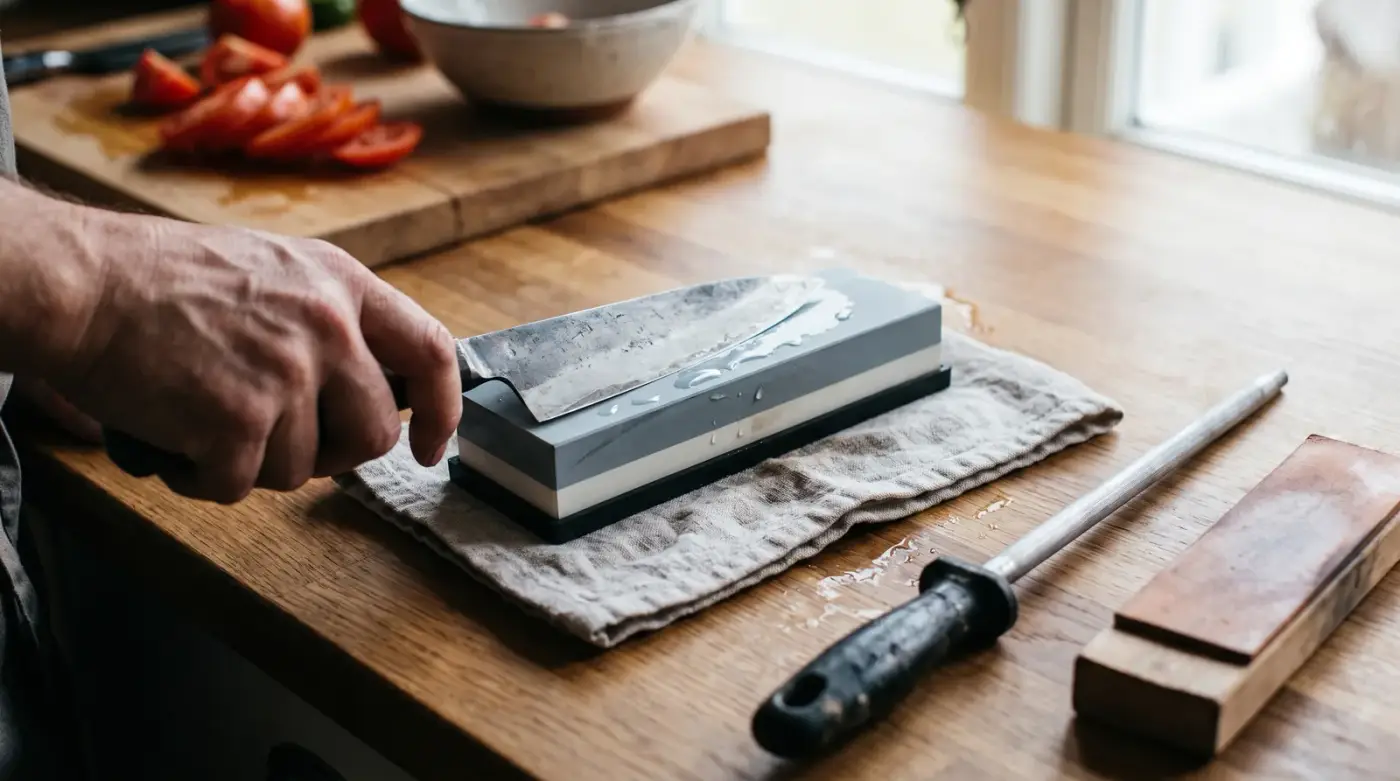
Soak the water stone for about fifteen minutes, until bubbles stop rising, then set it on a damp towel or its base, 1000 grit side up. Lubricate with water, never oil, on a water stone. Hold the blade at the chosen angle and make regular back-and-forth strokes with the same pressure, working section by section: heel, middle, tip. When you can feel a slight burr under your finger on the other side of the edge, switch sides, then turn the stone over to the fine grit to polish. A simple trick: colour the bevel with a marker; when the ink has disappeared evenly, you are holding the right angle.
Finishing on leather and caring for the stone
After the stone, a few strokes on a leather strop, spine first, remove the last burrs. Then rinse the stone in clean water, let it air-dry before putting it away, and do not leave it soaking permanently. Flatten it from time to time: a stone dished in the middle rounds the edge.
Habits that keep the edge
Cut on a wooden or polyethylene board, never on glass, marble or a plate. Wash the blade by hand, dry it immediately and store it in a block or on a magnetic strip rather than loose in a drawer. These habits space out sharpening sessions.
How we selected these models
I selected 12 sharpeners available on 07/10/2026 to cover every family (pull-through, electric, stone, roller, steel, strop) and every budget, from €13.49 to €124.09. For each one, I checked the price, availability and seller on the Amazon listing, then cross-checked the abrasive, angle, grit, accepted blades and origin against the maker's spec sheet. When Amazon and the maker disagree, the maker decides: Victorinox gives the Czech Republic as the origin of its sharpener, which the Amazon listing calls Swiss and then German. The Wüsthof and Sharpal websites blocked reading on the day we checked: for the Precision Edge I relied on a specialist retailer, and for both Sharpal products on the brand store's Amazon listing. A value that cannot be found or is contradictory is marked "n.c.". None of these sharpeners has been tested in hand: the rating out of 5 is an editor's review based on the abrasive, the accuracy of the angle, versatility, the maker's spec sheet and the price. Details are on our method page.
The models we left out
- Chef'sChoice Trizor XV: listed at €195.02 on 07/10/2026, it was shipped by Amazon US, so it is imported; check the electrical supply before buying.
- HORL 2 walnut: listed at €181.13 on Amazon on 07/10/2026, from an Amazon US seller, when HORL sells it for less on its own website; the HORL 3 Cruise uses the same principle.
- Global MinoSharp Plus 3: listed at €62.64 on 07/10/2026, with limited stock and shipped by Amazon US; it is a water sharpener with three ceramic wheels, with no maker's spec sheet available on the day we checked.
- Naniwa 1000/3000 combination stone: listed at €34.90 on 07/10/2026, with an Amazon listing giving wrong dimensions (65 x 185 x 32 cm); the King KW-65 covers the same use with a finer finishing grit.
- ZWILLING ceramic steel 23 cm: listed at €57.44 on 07/10/2026, from a third-party seller only.
- Lansky guided sharpening kit: listed at €59.75 on 07/10/2026, with no identified seller on the day we checked; its clamp system is aimed mainly at pocket and hunting knives.
- Miyabi ceramic disc sharpener: no price or offer on Amazon on the day we checked.
The price shown on Amazon when you buy is the one that applies.
Frequently asked questions
What is the best way to sharpen a knife?
A water stone gives the finest edge: 1000 grit to sharpen, 3000 to 6000 to polish, then a few strokes on leather. It requires holding the angle by hand. Without that learning curve, a rolling sharpener or an angle guide gives consistent results; a pull-through sharpener remains the quickest option for everyday upkeep.
What is the tool for sharpening a knife called?
You will hear sharpener for pull-through and electric tools, whetstone or sharpening stone for the stone, and honing steel or sharpening steel for the rod you draw the blade along. The leather used for finishing is called a strop.
How do you get a razor-sharp knife?
You need a polished edge with no burr. Sharpen on a 1000 grit stone until you feel a slight burr on each side, polish on 6000 grit or finer, then draw the blade over leather, spine first, alternating sides. A constant angle matters more than how fine the grit is.
What is the difference between a sharpener and a knife grinder?
A sharpener is the tool, or the person, that sharpens. A knife grinder is the craftsman who sharpens blades on a wheel, once door to door, today in a workshop or at markets. For a damaged or chipped knife, a professional grinder or cutler reshapes the bevel better than a home sharpener.
How often should you sharpen your knives?
For daily use, hone on a steel every week, or before each big cutting session, and sharpen on a stone or sharpener two to four times a year. A knife used rarely can wait a year. The paper test tells you when to do it better than the calendar.