









A kitchen knife is chosen first by the job it does: slicing and chopping with a chef's knife, peeling and trimming with a small paring knife, cutting bread with a serrated blade. Then come the steel (stainless, carbon, Damascus or ceramic), whether it is forged or stamped, and how much care it needs. I compared 16 products sold on Amazon France, from German makers (Wüsthof, Zwilling) to Japanese ones (Global, Kai), along with Victorinox, Opinel, Tefal, Fiskars and Kyocera. For each one, I read the manufacturer's page, checked the price on 07/10/2026 and wrote down its drawback plainly.
Selection
| Model | Rating | Type | Lame | Acier | Dishwasher-safe | Price | See the offer |
|---|---|---|---|---|---|---|---|
| Victorinox Fibrox chef's knife 20 cm (5.2063.20) For a first proper chef's knife that does everything | 4.5/5 | Chef's knife | 20 cm | Stainless | Tolerated, hand wash advised | €39.00Price checked on 07/10/2026 | ViewSee the offer |
| Wüsthof Classic chef's knife 20 cm For a forged chef's knife built to last | 4.5/5 | Chef's knife | 20 cm | German stainless | No | €125.00Price checked on 07/10/2026 | ViewSee the offer |
| Zwilling Four Star chef's knife 20 cm For a German forged knife at a sensible price | 4.5/5 | Chef's knife | 20 cm | Stainless, FRIODUR ice-hardened | No | €52.43Price checked on 07/10/2026 | ViewSee the offer |
| Global G-2 chef's knife 20 cm For a light, all-steel Japanese chef's knife | 4.5/5 | Chef's knife | 20 cm | Cromova 18, 56 to 58 HRC | No | €105.00Price checked on 07/10/2026 | ViewSee the offer |
| Opinel Les Essentiels box (No. 112, 113, 114, 115) For small jobs: paring, tomatoes, vegetables, peeling | 4.5/5 | Paring, serrated, vegetable, peeler | n/a | Sandvik 12C27 stainless | n/a | €27.54Price checked on 07/10/2026 | ViewSee the offer |
| Victorinox Swiss Classic bread knife 21 cm For slicing bread and thick crusts | 4.5/5 | Bread knife | 21 cm | n/a | Yes | €25.25Price checked on 07/10/2026 | ViewSee the offer |
| Victorinox Rapid peeler For peeling fruit and vegetables fast | 4.5/5 | Peeler | n/a | n/a | Yes | €7.16Price checked on 07/10/2026 | ViewSee the offer |
| Zwilling Professional S 7-piece knife block For kitting out the whole kitchen in German forged knives | 4.5/5 | Block | n/a | Stainless, FRIODUR ice-hardened | n/a | €129.99Price checked on 07/10/2026 | ViewSee the offer |
| Victorinox Fibrox fluted santoku 17 cm For trying a santoku on a small budget | 4/5 | Santoku | 17 cm | Stainless | Tolerated, hand wash advised | €37.97Price checked on 07/10/2026 | ViewSee the offer |
| Kai Shun Classic fluted santoku 18 cm For a Damascus steel Japanese santoku | 4/5 | Santoku | 18 cm | 32-layer Damascus, VG-MAX core, 61 HRC | No | €180.00Price checked on 07/10/2026 | ViewSee the offer |
| Wüsthof Chinese chef's knife 18 cm For slicing vegetables the Chinese way | 4/5 | Chinese chef's knife | 18 cm | Stainless, 56 HRC | No | €78.34Price checked on 07/10/2026 | ViewSee the offer |
| Kyocera Gen ceramic paring knife 11 cm (FK-110) For slicing fruit and vegetables with no metallic taste | 4/5 | Ceramic paring knife | 11 cm | Zirconia ceramic | Yes | €44.90Price checked on 07/10/2026 | ViewSee the offer |
| Tefal Ice Force chef's knife 20 cm (K2320214) For a cheap backup chef's knife | 4/5 | Chef's knife | 20 cm | German stainless | Yes | €19.99Price checked on 07/10/2026 | ViewSee the offer |
| Tefal EverSharp Pro 6-piece block with built-in sharpeners For knives that stay sharp without thinking about it | 4/5 | Block with sharpener | n/a | Stainless | No | €119.99Price checked on 07/10/2026 | ViewSee the offer |
| Opinel No. 102 carbon steel paring knives (set of 2) For trying carbon steel for very little | 4/5 | Paring | n/a | Carbon | No | €15.37Price checked on 07/10/2026 | ViewSee the offer |
| Fiskars Edge tomato knife 13 cm For cutting tomatoes and thin skins without squashing | 4/5 | Tomato knife | 13 cm | n/a | Tolerated, hand wash advised | €13.99Price checked on 07/10/2026 | ViewSee the offer |
Ranked by our rating, then by popularity. No retailer pays for its place. Our method. Prices and availability may change. The price shown on Amazon when you buy is the one that applies.
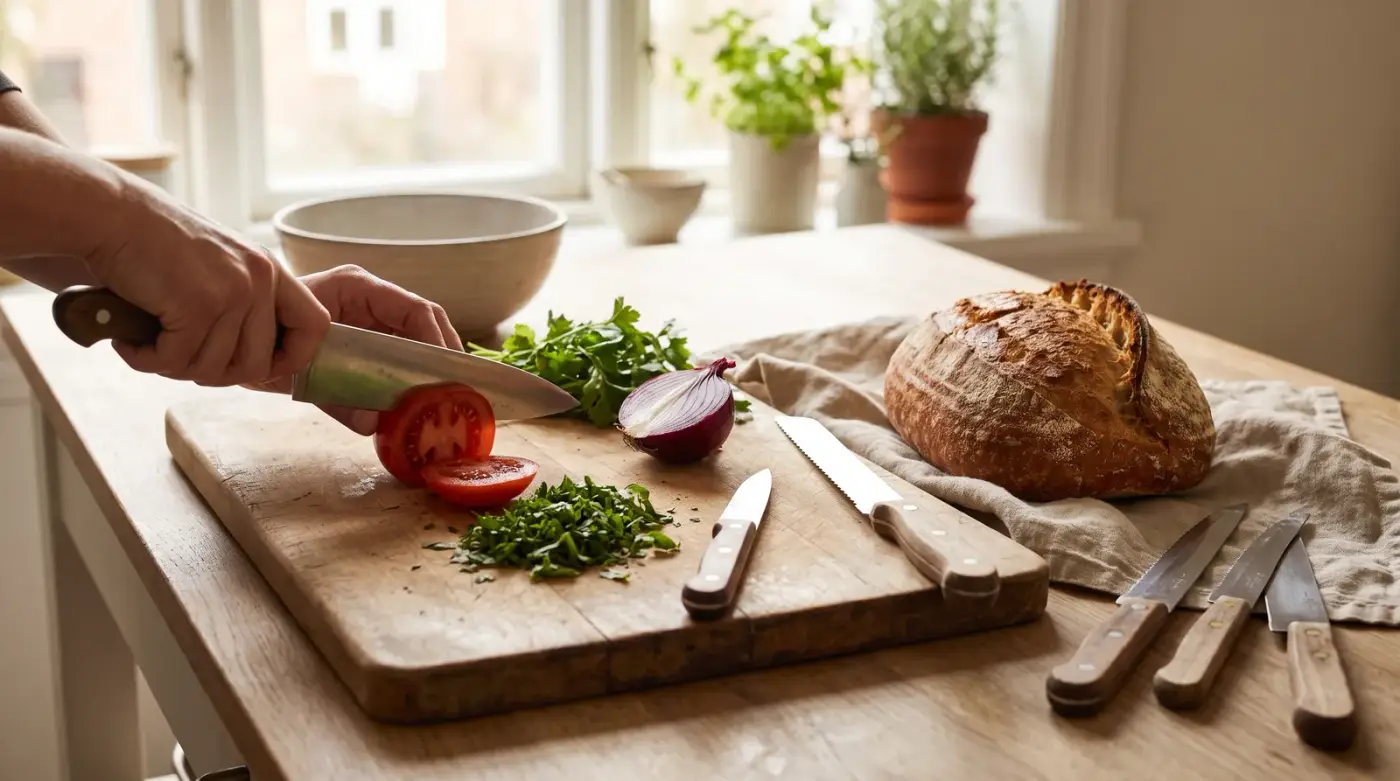
Our kitchen knife comparison for 2026
The detailed comparison picks the best models for each type of buyer, with a review of each one and what each maker does best: you will find it on our best kitchen knife page. This page helps you pick the right type of blade first.
Which type of kitchen knife should you choose?
Each type of knife does a specific job: the chef's knife handles most of the work, and the others cover bread, meat, fish and small prep. The table at the end of this section sums up the families.
The chef's knife
The chef's knife has a wide blade of 15 to 25 cm that curves slightly toward the tip: you rock it to slice, mince herbs and chop garlic. It is the first one to buy. The 20 cm models in our selection (Fibrox, Four Star, Wüsthof Classic, Global G-2, Tefal Ice Force) cover every budget. That length suits most hands; for a small cutting board or a small hand, 15 cm is easier to handle. Our chef's knife page is dedicated to it.
The santoku and other Japanese knives
The santoku is the Japanese take on the chef's knife: a shorter (16 to 18 cm), taller blade with a rounded tip, often fluted so potato slices do not stick. You use it with a straight down cut rather than a rocking motion. The 17 cm Fibrox lets you try the shape for little money; the 18 cm Kai Shun Classic in Damascus steel is made in Japan. The nakiri (a rectangular vegetable blade) and the gyuto (the Japanese chef's knife) are the two other shapes worth knowing. Our Japanese knife page covers them.
The paring knife and the vegetable knife
The paring knife, 8 to 11 cm long, is for peeling, trimming and cutting julienne or brunoise. The vegetable knife is a variant with a straight or bird's beak blade. Opinel, the brand from Savoie in the French Alps, made these its speciality: the Les Essentiels box holds a No. 112 paring knife, a No. 113 serrated knife, a No. 114 vegetable knife and a No. 115 peeler. Our paring knife page goes into this family in detail.
The bread knife and the tomato knife
A serrated blade bites into hard or slippery surfaces without crushing what is underneath: bread crust, tomato skin, citrus. A bread knife is 20 to 22 cm long, like the 21 cm Swiss Classic; a tomato knife is a small 11 to 13 cm model, like the Fiskars Edge. A well-sharpened straight edge will also cut a tomato, but a serrated edge keeps its bite longer. Our bread knife page covers it in detail.
The boning knife, the carving knife and the fillet knife
For home butchery and fish, there are three specialist blades: the boning knife (short and stiff, it follows the bone), the carving knife (long and thin, for a roast or a ham) and the fillet knife (flexible, it slides along the bones of a fish). The Victorinox Swiss Classic 20 cm filleting knife was listed at 30.67 euros on 07/10/2026, with 3 to 4 days' delivery. You use these less often: buy them when you prepare your own cuts. Our meat knife page covers boning knives.
The Chinese chef's knife and the cleaver
The Chinese chef's knife looks like a butcher's cleaver, but it is mostly for slicing: its tall blade (7.7 cm on Wüsthof's 18 cm model, according to the maker) crushes garlic flat and scoops up chopped food to tip it into the wok. Wüsthof advises against using it on bones. To split a carcass you need a real cleaver, thicker and heavier. Do not confuse the two when you buy.
The vegetable peeler and other tools
A peeler removes a thin skin without wasting the flesh. The Rapid (straight blade, 13 g) and Opinel's No. 115 are the classics. An electric knife is for large roasts and sandwich bread: our electric knife page covers it. Kyocera's ceramic stays sharp for a long time but does not like knocks; it has its own ceramic knife page.
Knife blocks, sets and storage
A block holds 4 to 6 pieces, scissors and sometimes a sharpener: it often costs less than buying each one, and it protects the edge, which gets damaged loose in a drawer. Zwilling's Professional S (7 pieces, 23 cm honing steel) and Tefal's EverSharp Pro (a sharpener in every slot) are the two in our selection. To compare sets, see our knife set page, and to store the knives you already have, our knife block page.
| Type of knife | Main jobs | Strength | Limit | Price on 07/10/2026 |
|---|---|---|---|---|
| Chef's knife | Slicing, mincing, chopping | Does almost everything | Bulky for small jobs | 19.99 to 125.00 euros |
| Santoku | Straight cuts, thin slices | Tall, fluted blade | Less suited to rocking | 37.97 to 180.00 euros |
| Paring and vegetable | Peeling, trimming, dicing | Precise and light | Too short for large pieces | 15.37 to 44.90 euros |
| Bread and tomato (serrated) | Crusts, thin skins | Keeps its bite | Cannot be sharpened like a straight edge | 13.99 to 25.25 euros |
| Chinese chef's knife | Slicing, crushing, scooping | Tall, versatile blade | Not made for bones | 78.34 euros |
| Peeler | Peeling | Fast, little waste | Does not replace a knife | 7.16 euros |
| Block or set | Kitting out the kitchen | Lower price per piece | Pieces you never use | 119.99 to 129.99 euros |
The price shown on Amazon when you buy is the one that applies.
How to choose a kitchen knife
Choose a kitchen knife on five criteria: the blade steel, how it is made, the handle, the length and the care it needs.
Steel: stainless, carbon, Damascus or ceramic
Stainless steel resists corrosion and needs no special care: most of the models in our selection use it. Its hardness is measured on the Rockwell scale: 56 HRC on Wüsthof's Chinese chef's knife, 56 to 58 on the Global G-2 in Cromova 18, 61 on the VG-MAX core of the Kai Shun. The harder the steel, the longer the edge lasts, but the more brittle the blade. Carbon steel (60 for the Opinel No. 102 according to a retailer) is very easy to sharpen but rusts if left damp. Damascus steel layers sheets of steel (32 on the Shun) around a hard core: it is as much about looks as about cutting. Kyocera's zirconia ceramic never rusts and leaves no metallic taste, but it breaks if knocked.
Forged or stamped: bolster, tang and balance
A forged knife is shaped from a single heated piece of steel, with a bolster (the thick part between blade and handle) that protects your fingers and balances the knife: that is the case for the Wüsthof Classic, as well as the Four Star and the Professional S block, which Zwilling ice-hardens (its FRIODUR process) in Germany. A blade stamped from a steel sheet, like the Fibrox santoku, is lighter and cheaper; its edge depends mostly on the steel and the sharpening. A full tang (steel running the whole length of the handle, visible between the scales and the rivets) adds strength; the Four Star has a tang hidden inside a synthetic handle. Where a knife is made guarantees nothing on its own: the Sabatier name, for instance, is used by several makers, from forged knives made in Thiers to models produced in Asia, and Laguiole is a style more than a brand.
The handle: wood, synthetic or steel
The handle decides comfort over time. Wood (beech at Opinel, olive at Sabatier K, pakka on the Kai Shun) feels good but hates the dishwasher. Synthetic handles (POM, polypropylene, non-slip elastomer) cope better with water. The Global G-2 is all stainless steel, blade and handle in one piece, with no joint for dirt to collect in. Symmetrical blades suit right and left handers alike; Fiskars says so for its tomato knife.
Blade length for your hand and your board
Aim for 20 cm for a chef's knife, 16 to 18 cm for a santoku, 9 to 11 cm for a paring knife and 20 to 22 cm for bread. A knife longer than the cutting board becomes dangerous: pick a board at least as wide as your longest knife, in wood or polyethylene rather than glass, which dulls the edge. A tall blade (santoku, Chinese chef's knife) guides the curled fingers of the hand holding the food.
Sharpening, honing and care
A dull edge is more dangerous than a sharp one, because it slips instead of cutting. Honing on a steel before each big prep session straightens the edge; sharpening on a stone or with a sharpener reshapes it when the steel is no longer enough. Stick to the maker's edge angle: 15 degrees on the Global G-2, 14 degrees on the Wüsthof Classic according to a retailer. Kyocera offers a sharpening service for its ceramic knives. Wash by hand, dry at once, and store in a block or on a magnetic strip. Our advice on equipment is on our knife sharpener page.
Cheap or high-end kitchen knives: what budget?
A kitchen knife costs from 7 to 180 euros based on our checks on 07/10/2026. The price follows the steel and the construction more than the name on the blade.
- Under 20 euros: cheap models that do the job well, such as the Rapid peeler (7.16 euros), the Fiskars tomato knife (13.99 euros), the two carbon No. 102 (15.37 euros) or the 20 cm Tefal Ice Force (19.99 euros).
- 25 to 55 euros: good stamped blades, small boxed sets and ceramic, from the Swiss Classic bread knife (25.25 euros) to the forged Four Star (52.43 euros), with the Kyocera at 44.90 euros.
- 75 to 130 euros: knives forged in Solingen, the Japanese Global and the blocks, from Wüsthof's Chinese chef's knife (78.34 euros) to the Professional S block (129.99 euros).
- Above that: Japanese Damascus steel, such as the Shun Classic santoku (180.00 euros).
The price shown on Amazon when you buy is the one that applies.
For heavy use, a professional knife is not necessarily the most expensive: Victorinox presents its Fibrox range, with a non-slip synthetic handle, as a tool for professionals. Our professional knife page compares them. Other kitchen utensils, from boards to colanders, have their own kitchen utensils section.
How we selected these models
I picked 16 products in stock or in limited stock on 07/10/2026, covering every type and every budget. For each one, I checked the price, availability and seller on the Amazon France listing, then cross-checked blade length, steel and care with the manufacturer's page or, failing that, a specialist retailer's page; a value I could not find or that contradicted another source is marked "n.c.". I left out a Sabatier listing whose title (a 20 cm chef's knife) contradicted its description (a 6 cm paring knife). None of these knives has been tested hands-on: the rating is the editor's, based on the specifications.
Frequently asked questions
What are the 3 essential kitchen knives?
A 20 cm chef's knife, a 9 to 11 cm paring knife and a 20 to 22 cm serrated bread knife. The chef's knife slices, minces and chops; the small knife peels and trims; the serrated blade cuts crusts and tomatoes. Add a peeler to work faster, then a boning or fillet knife only if you prepare your own meat and fish.
What is the best kitchen knife?
There is no single answer: the best kitchen knife is the one that suits your hand and the care you are willing to give it. If you buy only one, take a 20 cm stainless steel chef's knife, forged if you like some weight, stamped if you prefer it light. Our detailed comparison picks the best models for each profile.
Santoku or chef's knife: which should you choose?
The chef's knife, longer and curved, suits a rocking motion and large pieces. The santoku, shorter and taller, suits straight cuts and thin slices, and its flutes reduce sticking. If you mostly slice vegetables, go for the santoku; if you cook everything, the chef's knife.
Is a knife block with a built-in sharpener a good idea?
Yes if you never sharpen: each pass through the slot restores the edge with no technique to learn. The limits: the system does not handle serrated blades (Tefal says so for its bread knife), it ties you to the brand's knives, and a whetstone still gives a finer edge. A standard block means sharpening yourself but takes other knives.
Can kitchen knives go in the dishwasher?
Avoid it, even when the listing allows it. Knocks against other cutlery dull the edge, detergent fades wood and moisture attacks carbon steel. Victorinox and Fiskars tolerate the dishwasher but recommend hand washing; the listings for the two German forged chef's knives, the Global and the Shun rule it out. Wash in hot water and dry at once.